
The Problem with French Policing: 12 films
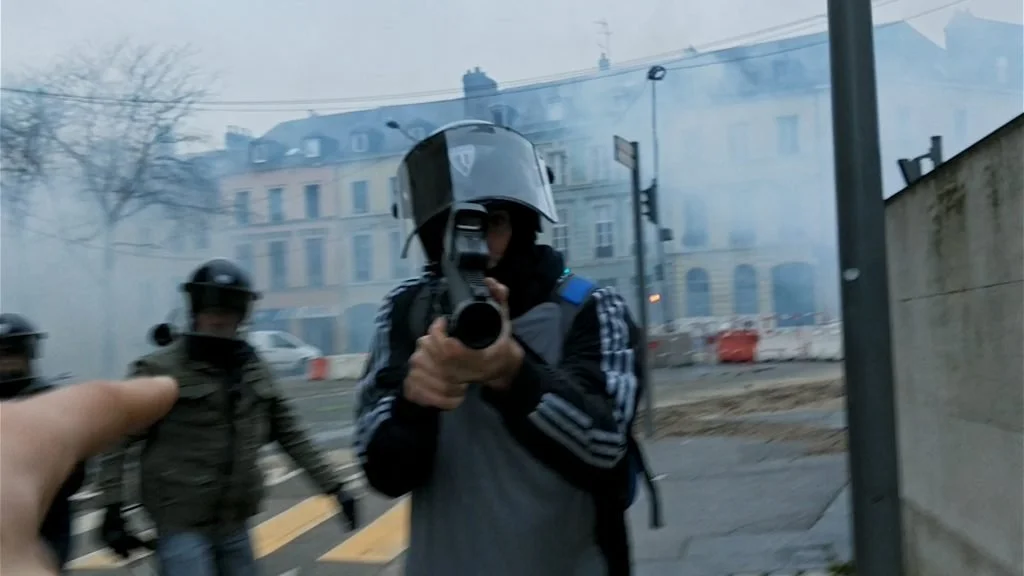
Since it was triggered in September by the students, parents and teachers of the Lycée Saint-Exupéry in the Paris suburb of Créteil, the Mouvement lycéen has set France ablaze. Despite the mostly peaceful nature of the movement, violent exchanges between police and students have erupted outside hundreds of blocked high schools, flooding social media with pictures of chaos, but also hundreds of witness accounts of police brutality against minors.
What role have the French police and government played in exacerbating the violence of the Mouvement lycéen? Not only have 7 950 students been arrested - a record in such a short amount of time - but more than 200 have been injured by police, with 36 investigations now open against officers by the IGPN, the police body responsible for investigating wrongdoing in the force.
Instead of responding to the movement’s legitimate demands: a teacher for every class, functioning toilets and liveable classrooms, Emmanuel Macron’s government has systemically sought to stamp out the movement, using the national police force (Gendarmerie) and riot police (CRS) as tools of repression.
A fourteen-year-old girl was filmed being strangled by a police officer, a sixteen-year-old boy was shot in the face at point blank range with a rubber bullet, breaking his jaw and teeth, a seventeen year-old girl has lost the use of one eye and a fifteen-year-old boy’s hand was blown off by a stun grenade. Outrage has spread through social media and inspired many parents and adults to join the student movement to try and protect children from the police.
Yet police brutality is not a new problem in France. From its colonial origins, to how they’re trained, to the brave families fighting for justice in court, here are 12 films with which to explore and understand the subject in depth.
For this list, we asked you to share your suggestions, thank you to everyone who participated, follow us on Instagram to take part in the next one.
Here We Drown Algerians: October 17th, 1961 (2011) by Yasmina Adi
Not only did the 17th of October 2026 mark the biggest day of protest in France since the start of the Mouvement lycéen, it was also 65 years since the deadly events of October 17th 1961.
In the midst of Algeria’s war for independence from France, 30,000 immigrant Algerian workers marched to Paris in order to protest peacefully. They were met with brutal violence, the police killing up to 300 people by some estimates. Many bodies were found in the Seine in the following days, or buried in the woods surrounding the city.
Blending testimony and unseen archive footage, history and memory, past and present, the film recounts events and reveals the strategy and methods applied at the highest level of the French state: manipulation of public opinion, the systematic challenge of every accusation, the censoring of information in order to prevent investigation...
Paris Stalingrad (2019) by Hind Meddeb
Paris Stalingrad by journalist and filmmaker Hind Meddeb (Electro Chaâbi, Soudan Remember Us…) takes us into the migrant camps of North-eastern Paris, where she “decided to pick up [her] camera and shoot. To show what [her] city imposes on newcomers.”
When it comes to dealing with migrants and asylum seekers, the government’s principal instrument in dealing with the issue is the Police. Instead of empathy, understanding and hospitality, political and economic refugees are met with disregard, persecution and violence. A vicious cycle in which the police play a major role, raiding and destroying camps like those in Stalingrad on a regular basis.
With constant roundups, unlawful destruction of property and herding away from central Paris of black and brown bodies, the French police still upholds a policy of dehumanisation born in colonialism.
You can watch the film for free below.
I Am France (2023) by Sarah El Attar
Suggested by Théotime Pelsy
That same racism is applied to non-white French citizens, who for decades have been sounding the alarm on the daily persecution they suffer at the hands of the police, particularly in the banlieues. Many have lost their lives to police brutality, with their families fighting the system for justice since.
Sarah El Attar’s film brings together many of the emblematic figures of the fight against police brutality in France: Ramata Dieng, sister of Lamine Dieng (killed in 2007), Assa Traoré, sister of Adama Traoré (killed in 2016), as well as Mahamadou Camara, brother of Gaye Camara (killed in 2018), Farid El Yamni, brother of Wissam El Yamni (killed in 2011), and Awa Gueye, sister of Babacar Gueye (killed in 2015).
The film lends its voice to the people of the banlieues, who share their experiences with the police and its institutionalised level of racism and violence.
Brotherhood (2021) by Ugo Simon
Mamadou Camara and Farid El Yamni are also the subjects of Ugo Simon’s film. They’re joined by Diané Bah. All three men have had a brother wrongfully killed by the police and have been seeking justice since.
“There's always a member of the family who has to sacrifice themselves. In the Camara family that's me.”
One after the other they reveal themselves to camera, speak of their suffering, the impact of their loss, the lack of closure and their determination to find justice.
A simple yet powerful film that goes beyond taking account to grant its subjects the time needed to speak of love, life and injustice.
Constrain (2020) by Fleuryfontaine
We are all prisoners of a nationality, a social condition, a skin colour, to which the police and state repression force us to resign ourselves. Antoine Fontaine and Galdric Fleury’s (Fleuryfontaine) breathtaking experimental film uses 3D rendering to evoke how the body suffers, under blows, constraint and humiliation.
Kindertotenlieder (2021) by Virgil Vernier
In the same banlieues, police killings have on several occasions triggered mass riots. The first major one being in 2005 in Clichy-sous-Bois after two young men were chased into an electric plant and died by electrocution.
Kindertotenlieder is an archive film composed solely of images from TV coverage of the event assembled and edited, with commentary removed, by Virgil Vernier. A poised and sobering retelling of a tragic series of events, a neighbourhood of second-class citizens facing not just the injustice of callous police brutality, but also a fierce and totalitarian repression following the riots.
The start of 20 years of police radicalisation, and the integration of a new doctrine built to deal with “urban violence” that would soon be deployed against an ever wider spectrum of people and events.
The Monopoly of Violence (2020) by David Dufresne
Suggested by Sacha Noel
The Gilets jaunes movement in 2018 marked a cornerstone moment in French police doctrine. In response to a fierce and determined nationwide social movement less than a year into his first term in office, Emmanuel Macron’s government unleashed a heavily armed and repressive police to stamp out the movement, killing 11 people in the process.
For many, as anger and resentment grew in the face of social inequalities, this raised major questions about the legitimacy of the police and the state. In this major documentary, David Dufresne gathers a panel of citizens to question, exchange and confront their views on the social contract and the legitimacy of the use of force by the State.
The Monopoly of Violence was selected at Cannes’ Directors fortnight and in the César’s Best documentary category the year of its release.
On ne sait jamais ce qu’on filme (2016) by Matthieu Bareyre, Thibaut Dufait
Suggested by Théotime Pelsy
One thing that has evolved in favour of protesters is the proliferation of smartphones and the ability to film police actions.
With his short On ne sait jamais ce qu’on filme ,which translates as: You never know what you’re filming, he demonstrates how banal and surreptitious police brutality has become during protests, and how easily it can be missed.
You can watch the film for free below.
Boom Boom (2022) by Laurie Lasalle
Suggested by Yohana Benattar
"I meet Pierrot in the fall of 2018. We protest together in the heart of the Gilets jaunes movement. The earth trembles and so do our hearts. Our bodies mingle with thousands of others who express their anger in the street every Saturday."
Boom Bom bares witness to the Gilets jaunes movement through the prism of a burgeoning love affair. An exceptional film that mingles political, militant and romantic awakening without holding back - a must-see.
Direct Action (2022) by Guillaume Cailleau, Ben Russell
Climate change activists have not been spared from police brutality and the movement has hardened in France, seeing the recent emergence of the Soulèvements de la terre collective and their strategy of direct action - “an action that seeks to achieve an end directly and by the most effective means”.
Direct Action documents the everyday lives of one of the most high-profile militant activist communities in France and asks whether the success of a radical protest movement can offer a path through the climate crisis.
The film awarded Best film in the Encounters section of Berlinale and received a Special mention in the documentary category, it won the Grand prix at Cinéma du Réel.
Grey Zone (2025) by Liza Guillamot
After decades of political promises to strengthen police numbers, the barrier for entry for recruits has lowered and training standards have too.
Set behind closed doors in a police academy, Grey Zone examines the vocation of young recruits but also the the gears of the system they are entering. The camera immerses itself in the daily routine of training, revealing a truth about the institution that is rarely accessible. Anonymity is insured thanks to software that uses images diverted from CCTV footage.
A subtly troubling and eerie reality check that won Best original soundtrack at FIPADOC and deserves more attention.
Young and Alive (2018) by Matthieu Bareyre
The last film of this list circles back to the student movement, youth and their demands for a better future.
Matthieu Bareyre wanders the streets of Paris, turning his camera and microphone to the city‘s young, lost in a world they no longer understand or care for. Seeking to change the rules, led by new personalities, driven by their values and ideals, they open a new dialogue, challenge the state and are getting ready for a new kind of revolution.
A seminal and necessary film that captures a struggling yet intelligent, effervescent generation in desperate need of being heard - with a little fun along the way.
Follow us on Instagram for updates and get in touch if you’d like to meet up or collaborate !