


Mexican Documentaries Are Having an American Moment: 4 To See
Mexican and Mexican-American documentary filmmakers are winning high-profile awards this film festival season including Mexicanamerican by Eddie Sanchez (2026 Audience Award for Best Documentary Feature at Tribeca, Closing Night Gala at 2026 GuadaLAjara Film Festival) and Daughters of the Forest by Otilia Portillo Padua (2026 Vision Audience Award at SXSW). Filmmakers are imaginatively experimenting with narrative, form and archive as they document the impacts of climate change, deforestation, migration, economic inequality and threats to Indigenous ways of life in Mexico.
Doc Weekly attended last week’s New Orleans Film Festival at which nine of the 189 screened films were by Mexican and Mexican-American filmmakers – six of them docs - including Mexicanamerican and Daughters of the Forest. NOFF hasn’t historically tracked data about Mexican films but the festival has confirmed it was the highest number in recent memory.
The other four documentaries screened were shorts and it was a Mexican film that won the NOFF Narrative Short jury prize (La Visita dir. by Miguel Melo). NOFF is Oscar-qualifying in all three Academy-accredited short subject categories. Timing also matters for these films. Mexicanamerican’s director Eddie Sánchez explained during a Q&A that his film (down to the styling of the title) was greatly influenced by Martin Scorsese's Italianamerican (1974) and that he homed in early on the potential for using his parent’s fraught US-Mexico border-crossing stories to find and educate the audiences he wanted to reach. Padua shared that she learned that mushrooms were having “a boom.” As more people try psychedelics, she recognized the opportunity to tell the story of Mexican foragers.
Something broader is happening. Many of these films use intimate, character-driven narratives to personalise complex, societal challenges. They also champion the perspectives of Indigenous, working-class and socially marginalised people consistent with older Mexican concepts of social realism. U.S. audiences are aligning as grassroots perspectives permeate our political discourse despite intense political pushback. November 2026 national election results in the U.S. seem to confirm they are taking root as an unprecedented wave of Indigenous, Hispanic, African American and other minority candidates were voted into high office across the country. These documentaries creatively deploy award-winning documentary filmmaking strategies to elevate the voices and concerns of specific Mexican people and places in jeopardy. But it will not always be clear as the credits roll who is to blame or who should be helping them, even when allusions are made. Curious audiences will need to connect the remaining dots themselves.
Director Otilia Portillo Padua’s film Daughters of the Forest, won an Honourable Mention in the documentary feature competition at the 2026 New Orleans Film Festival. Padua calls her film about Indigenous biologists Eliseete Ramírez Carbajal and Julieta Serafina Amaya Pérez, “an immersive sci-fi documentary.” She delivers on that promise by using language invoking the genre in the script and deftly using microphotography to reveal the otherworldly landscape of the forest floor. The script is composed of a chorus of perspectives, including that of the fungi (evoking the hallucinogenic effects of mushrooms), on what will be lost if Indigenous knowledge about the natural world is not heeded while illegal logging continues to spread.
Daughters of the Forest is highly imaginative documentary filmmaking that tells a novel, mycological (study of fungi) story from the literal ground-up. But after 90 emotional minutes depicting and speculating about what is at stake in staggering scientific and visual detail, the script leaves unanswered who specifically – and officially – is responsible for protecting these forests.
In the literary documentary short Un Día Llegará La Noche (Someday the Night Will Come), filmmaker Chica Barbosa conjures Xtabay, a lethal Mayan spirit who lures men with wandering souls into the Yucatán forests with “her haunting beauty and a voice like mist.” Virginio Euan Aban, fending off alcoholism and existential despair, is at risk of falling for Xtabay’s charms. The film opens with an on-screen story about Xtabay, then cuts to Virginio lying with eyes closed and a bottle of what looks like beer within reach. A haunting voice is heard off-camera. “It’s Xtabay. She’s calling me. The way she called you, Dad.”
Our growing empathy for Virginio’s tenuous hold on sobriety drives the film as we see a montage of vignettes documenting a fairly routine life accompanied by a script that veers hard into, if not strictly fable, a cautionary tale. There is a clear moral lesson at the centre of this beautiful film. However, practical truths about the adverse impacts of the federal government’s strategies for economic development through heritage tourism on working-class Indigenous people in the Yucatán (as signaled by repeated references to the Maya Train project) rarely come into focus.
Finally, Jean Chapiro’s short film La Mar (The Sea) documents a defining moment in Mexican history: the first relocations of coastal communities displaced by climate change. Cinematographer Jessica Arezate’s camera roams the remains of Guadalupe Cobos Pacheco’s fading fishing community in Tabasco. Carefully framed still-life tableaus of abandoned buildings are quietly ruptured by the relentless sea that seemed ready to crash out of the frame in our theatrical screening. Chapiro and Arezate breathe precious life back into the film by making good use of close-ups of sandy feet at play on a beach or a child’s head leaning on the concrete remains of an abandoned building to underscore that humanity will endure.
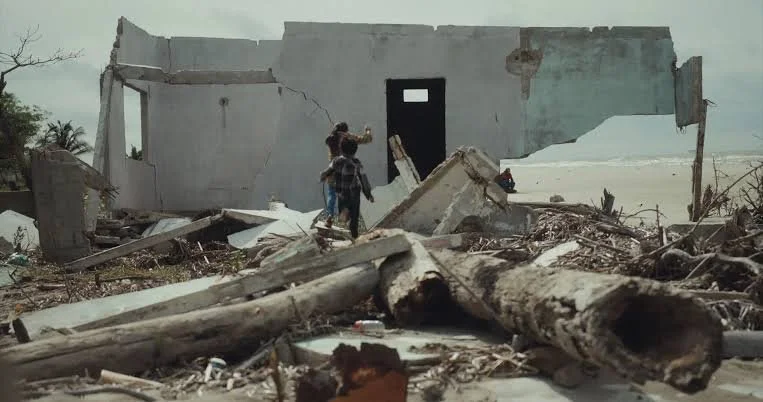
La Mar (2026) by Jean Chapiro
While she awaits relocation after a long campaign for help, Guadeloupe doesn’t blame the water. “The sea filled up. It grew tired. It couldn’t go on. It had nowhere else to go.” The film celebrates her advocacy but is less specific about who in the Mexican government (the local “municipality” is briefly referenced) is accountable to these coastal communities as they face existential threats. Important evidence appears in one of the film’s most visually stunning scenes. Turned to sea, the camera captures the blinking lights of fifteen off shore oil rigs illuminating the night.
Upcoming Screenings: Daughters of the Forest will show at the Tallinn Black Nights Film Festival (November 7, 9 and 10, 2026), Festival Internacional de Cine de Oruro (November 10-14, 2026), FILMéxico (November 19, 2026), Festival Internacional de cine de Mérida y Yucatán (November 21, 2006) and at other festivals this fall.
Both Mexicanamerican and La Mar can be seen at the upcoming GuadaLAjara Film Festival (November 5 - 7, 2026). Mexicanamerican will also screen at the St. Louis International Film Festival (Saturday, November 14, 2026) and at the Bainbridge Island Film Festival (November 15, 2026).